
Susan Sarandon Shares Her Thoughts on Fear, Freedom, and Independence
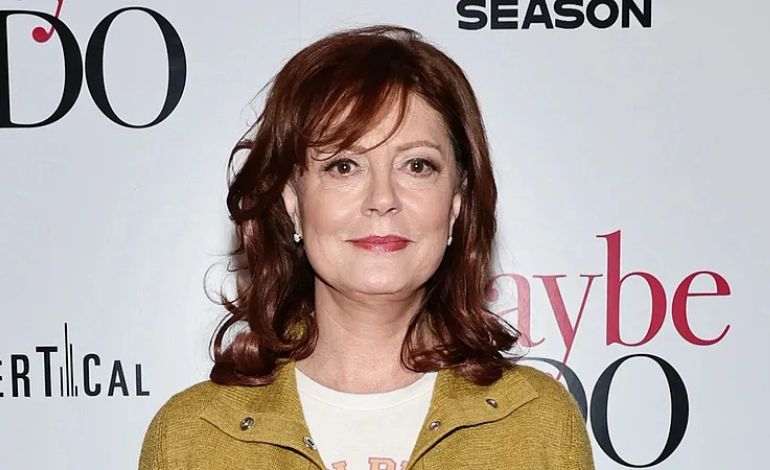

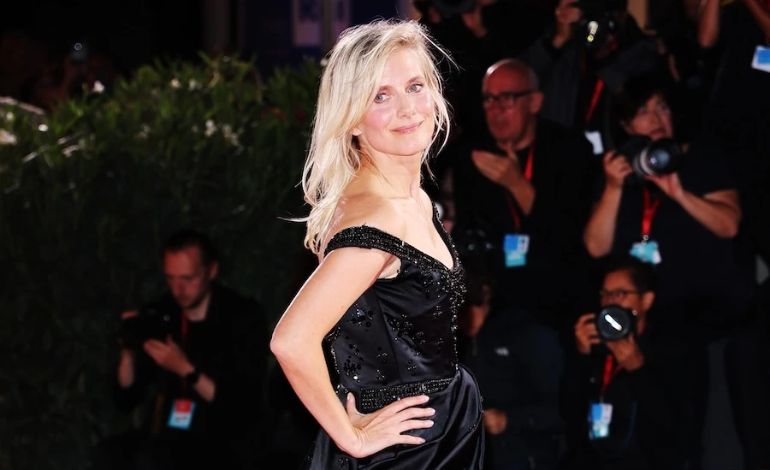
When Andrea Pallaoro’s “The Echo Chamber” premiered at the 83rd Venice International Film Festival on Sunday evening, it earned an eight-minute standing ovation, offering a warm reception for stars Luca Marinelli, Alicia Vikander, and Susan Sarandon at one of the festival’s most anticipated world premieres.
Based on Bernardo Bertolucci’s final screenplay and reworked with his original co-writers, Ilaria Bernardini and Ludovica Rampoldi, the film tells an intimate and unsettling story in which physical pain, emotional dependence, desire, and love gradually become impossible to separate. At its center is Leo, played by Marinelli, a troubled music producer whose life has been pushed to the edge by addiction and chronic pain. He meets Anne, a physiotherapist played by Vikander, who enters his life to treat his body but ends up reaching something far deeper. Both carry the scars of painful pasts, and their relationship becomes vivid, sensual, and sometimes overwhelming — two damaged people learning not simply to love one another, but to let love pass through them without turning it into dependence or control.
Running alongside their story is Ava, an aging singer played by Sarandon, who is working on what may become her final album while grappling with the loss of a long relationship and the question of who she is without it. Leo becomes her producer, emerging from an overdose just as Ava emerges from grief. The three characters are connected by different forms of damage, and by the possibility that another person can become both a mirror and a path back to oneself.
For Sarandon, who admits she rarely feels safe arriving on a film set, that emotional instability made the role frightening — but she considers fear part of the process. “I would always rather surrender to a director that has a vision than somebody who is already got it marketed,” she said. Pallaoro approached her about the role after taking on the challenge of adapting Bertolucci’s screenplay. Sarandon initially had questions about the character and even imagined a different musical direction, but the director persisted, eventually traveling to London to meet her and win her trust.
Reflecting on her ongoing relationship with fear, Sarandon said, “I am always frightened. It takes me weeks to settle down. I think the fear is part of the responsibility. I don’t have a plan, but I know what I don’t want. Being comfortable for me is always dangerous.” It’s an unexpectedly candid admission from an actress whose career has often been associated with confidence and fearlessness. What she describes instead is a willingness to remain exposed — waiting for other actors, staying open to the unexpected, and letting a scene change her.
At the heart of the film, Leo and Anne’s relationship repeatedly asks where care ends and dependence begins. Pallaoro, directing a screenplay he did not write for the first time in his career, describes the story as one in which physical and emotional pain distort the search for intimacy, while tenderness can gradually shift into control. Their love becomes a kind of mutual resurrection — neither arrives whole, and neither can simply fix the other.
Sarandon sees her own character’s arc in similar terms. Ava has lost the person who defined much of her adult life and must confront an unfamiliar version of herself. “When you form any kind of a partnership, that becomes an identity too,” Sarandon said. “The partnership identity. And I remember going off on location and being kind of scared. Because I’d be in some terrible motel or hotel in the middle of Texas somewhere. But I was like, okay, I remember, this is who I am. Opening your bag by yourself and you’re scared. But at the same time, it’s good to kind of review that. Before someone dies, it’s good to remember who you are.”
Ava’s voice, no longer what it once was, becomes central to her vulnerability as she records a new album with Leo. The songs become more than music — fragments of a former self, echoes of the woman she used to be. The film offers no clean transformation; Ava must find a way to carry who she was into who she is becoming. Sarandon compares it to a butterfly, where transformation continues rather than erases what came before — a particularly poignant idea given that her character’s voice, her most obvious source of power, is precisely what has changed with age.
Asked about the power of using one’s voice, Sarandon turns first to listening rather than speaking. “People speak out; they do. But do you know what people don’t do? They don’t listen. When my boys were starting to date, I would say, look, learn to cook two meals, and learn to listen. You don’t have to be entertaining, trust me. Just really listen, and you’re going to be fine with everybody. Because I think listening is a lost art. On screen, my superpower… I am a good listener,” she added with a laugh. “Being present and really listening.”
That quality shapes how she approaches acting more broadly — not as a demonstration of emotion, but as an act of openness. “I’m against that theory that you have to be really messed up to be talented,” she said. “I think it’s harder to be both a human being and an artist, but it is possible.”
That philosophy extends well beyond the set. Sarandon has spent years speaking publicly about AIDS activism, Haiti, social justice, and more recently, Palestine — a stance that has carried real professional consequences, including losing film roles and being dropped by the United Talent Agency in 2023. Yet when asked about courage, she rejects the term outright. “I don’t feel like I have courage at all,” she said, instead describing an “overdeveloped need for justice” that traces back to childhood memories of being troubled by unfairness, even something as small as swapping her dolls’ dresses so each would get a turn wearing the best outfit. “I just see myself as a little flashlight to put on information that maybe… it’s not that it’s necessarily successful or that I think I can make a huge difference or change them, but… I don’t want to change myself.”
There’s a lighter side to her public image too. Across the Arab world, where her outspoken positions have made her widely admired, she’s often referred to affectionately as “queen.” When told a colleague had described her that way, Sarandon burst out laughing. “Wait, does that include real estate?” Beneath the joke lies genuine affection — one that has only deepened even as her political stances have cost her opportunities in the US.
Inevitably, another presence lingers throughout “The Echo Chamber”: Bertolucci himself. Pallaoro inherited rather than wrote the screenplay, taking on the challenge of shaping his own film from the final work of one of cinema’s great directors. For Sarandon, that connection felt personal — she knew Bertolucci and remembers the deep impact of his films, particularly “The Conformist.” The apartment at the center of the story becomes both refuge and prison, its rooms, mirrors, and corridors constantly shifting the distance between characters, much like an echo — not an original voice, but one returned, changed by the space it has traveled through.
For Sarandon, acting seems to function much the same way. She never studied acting formally and doesn’t retreat permanently into a method. She can reach an emotional state, she said, but she also wants to be surprised by another actor, by music, by whatever happens in the moment — and when she goes home to her children, she leaves the character behind entirely. The vulnerability, she suggests, comes not from living inside a role permanently, but from being willing to open the door again each time she returns to set. “That’s what keeps you hooked, I think,” she said.
In “The Echo Chamber,” nearly every character is searching for a way out — from addiction, grief, an old identity, loneliness, or the fear of aging and intimacy itself. But the film suggests something more complicated than simple escape: perhaps people evolve not by leaving their broken selves behind, but by allowing another person, another voice, another love to reach the places they had stopped letting anyone enter. For Sarandon, the answer seems simpler still — listen, remain open, accept the fear, and refuse to become someone else simply because the world might find it more convenient. “I don’t want to change myself,” she said. At 79, in a film about voices, echoes, and reinvention, it’s a fitting note to leave her on.
Also Read:
Pilots Injured in Amazon Cargo Plane Crash Released From Hospital
EU Moves to Give Cities More Power Over Airbnb and Holiday Rentals