

Exploring the Beauty and History of the Arab Hall at Leighton House in London
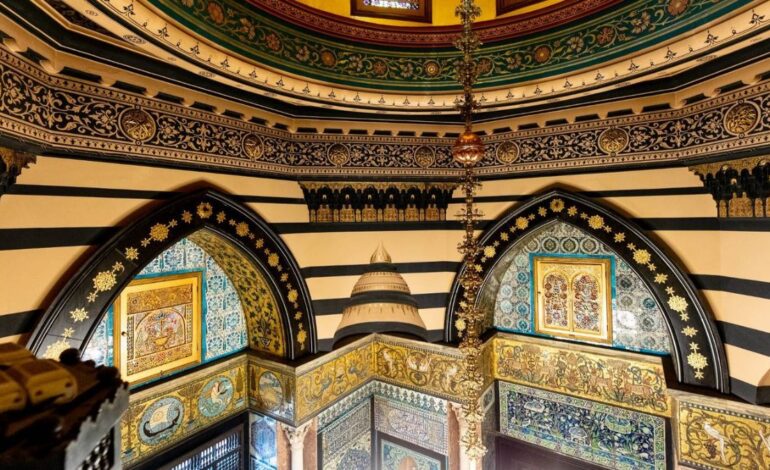

LONDON — To mark its 100th year as a public museum, Leighton House has opened a major exhibition titled “The Arab Hall: Past and Present,” placing one of its most celebrated interiors under a fresh lens. The show brings together contemporary art, film, and new scholarship to examine the legacy of the Arab Hall, completed in 1881.
Created by Victorian artist Frederic Leighton after extensive travels across North Africa and the Middle East, the Arab Hall is a striking example of cross-cultural design. Its intricate tiles — sourced from Damascus, Turkey, and Iran — merge Islamic, Mediterranean, and Victorian craft traditions into a richly layered space.
For the first time, the exhibition features site-specific commissions from three artists: Ramzi Mallat, Kamilah Ahmed, and Soraya Syed. Mallat’s work suspends thousands of blue‑glazed evil‑eye charms from the central chandelier, forming a “shielding canopy” inspired by medieval Ottoman helmets. Ahmed’s mixed‑media embroidered textile arch sits over the fountain, drawing from Damascene tiles, Iznik patterns, and mashrabiya screens. Syed projects animated calligraphy onto the water’s surface, treating script as a living force.
Syrian filmmaker Soudade Kaadan contributes a short film, “When the Tiles Spoke,” using magical realism and documentary to animate the hall’s antique tiles. New research by Dr. Melanie Gibson traces Leighton’s journeys and reconstructs his now‑dispersed Islamic art collection, fully transcribing the hall’s tiles and inscriptions to their original sites.
Senior curator Daniel Robbins said the project offers visitors a chance to experience the space not just as a historic interior but as one that continues to inspire curiosity, reflection, and discussion. The exhibition runs at Leighton House in London.
Also Read:
Why Enterprise Intelligence Is the Next Big Step for Growing Companies
How Three Key Priorities for Small Businesses in 2026 Can Drive Growth