






Humanoid and Bosch Join Forces to Accelerate Robot Production
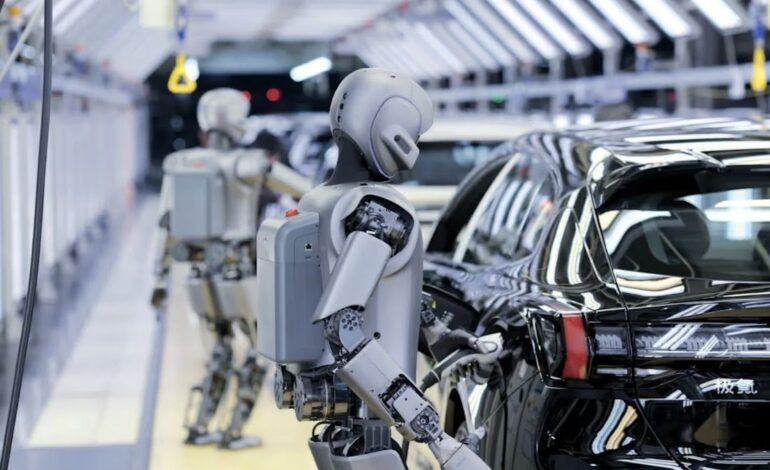

Robotics company Humanoid and industrial conglomerate Bosch have announced a partnership to bring the HMND 01 industrial robots into mass production, with plans for large-scale European deployment. The collaboration moves the robots from successful testing into what could represent a significant shift in warehouse automation and industrial labor.
Under the agreement, Bosch’s responsibilities extend beyond serving as a manufacturing contractor. The company will provide strategic guidance and technical expertise covering hardware design, production efficiency, supply chain optimization, and cost reduction. This deeper involvement signals Bosch’s confidence in the technology and its commitment to making the robots commercially viable at scale.
Two Models for Different Needs
Humanoid offers two distinct versions of the HMND 01 platform, each suited for different operational environments. The bipedal model closely mimics human proportions at 5 feet, 10 inches tall and weighing 198 pounds. It can walk at nearly 5 feet per second and operates for approximately three hours on a single charge.
The wheeled model takes a different approach, sacrificing human-like appearance for increased capability. Standing 7 feet, 3 inches tall and weighing 661 pounds, it can move at 6.6 feet per second and run for four hours without recharging. Both models can handle payloads of 33 pounds, positioning them for material handling tasks in warehouse and manufacturing environments.
Proven Capability in Real-World Conditions
The partnership builds on successful testing conducted in March at a Bosch facility in Bühl, Germany. In that proof-of-concept demonstration, HMND 01 robots performed complex warehouse tasks including transferring boxes from conveyor belts to trolleys. Critically, the test involved boxes of varying sizes, shapes, heights, and weights—simulating real-world conditions rather than simplified scenarios.
Humanoid emphasized that the robots “demonstrated full capability in a complex industrial workflow,” with the test validating both technical readiness and the scalability of the approach. The robots rely on Humanoid’s KinetIQ framework—a system enabling them to understand and interact with their environment—to perform these tasks autonomously.
Strategic Integration Potential
The Bosch partnership extends beyond current production arrangements. Bosch manufactures components including actuators, drives, and sensors that could be integrated into future robot models. This vertical integration strategy could improve performance, reduce costs, and deepen Bosch’s stake in the robotics venture. It also creates a scenario where Bosch components enable robots potentially manufacturing future iterations of those same components.
This kind of supply chain involvement strengthens the partnership and aligns incentives. Rather than Bosch simply manufacturing finished robots designed by others, the company has opportunity to shape the technical direction and reduce manufacturing costs through component integration.
Implications for European Warehousing
For warehouse workers, the announcement signals accelerating automation in logistics and material handling. Humanoid robots capable of handling boxes of varied dimensions and weights can address tasks currently requiring human workers. As deployment scales across Europe, warehouses may face significant labor displacement in roles focused on material movement and simple logistics tasks.
The timing coincides with broader industry trends toward warehouse automation. Rising labor costs, supply chain complexity, and pressure to improve efficiency have created strong incentives for companies to invest in robotic systems. Humanoid’s combination of bipedal and wheeled platforms provides flexibility for different warehouse layouts and operational requirements.
The Broader Robotics Landscape
The Humanoid-Bosch partnership reflects growing confidence in humanoid robotics for industrial applications. While early humanoid robots were often positioned as research projects or long-term visions, systems like the HMND 01 are moving into near-term commercial deployment. Successful real-world testing and partnerships with established industrial companies signal that the technology has matured beyond experimental phase.
For competitors in the robotics space, the announcement suggests that partnerships with established manufacturing companies may be essential for scaling production and achieving commercial viability. Humanoid’s access to Bosch’s manufacturing expertise, supply chain, and market relationships represents advantages that smaller competitors or companies without such partnerships may struggle to match.
Cost and Scalability Questions
The real test of the partnership will be whether Humanoid and Bosch can achieve cost structures that make robots economically viable for widespread deployment. Industrial customers make purchasing decisions based on return on investment calculations comparing robot costs against labor savings and efficiency gains.
As production scales, manufacturing costs typically decrease. Bosch’s involvement in cost optimization and supply chain efficiency is specifically oriented toward reaching price points that make robots compelling investments for companies managing European warehouses and manufacturing facilities.
The partnership represents a significant moment in the transition of humanoid robotics from development projects into production systems. Whether this specific collaboration will dominate European warehouse automation or represent one among many competing approaches will become clearer as deployment accelerates through 2026 and beyond.
Also Read:
The Strange New Way People Are Speaking to Gemini Online
Google Introduces Powerful AI Features for Faster Android Performance