





UAE Powers Ahead With 63-Fold Growth in Renewable Energy Capacity
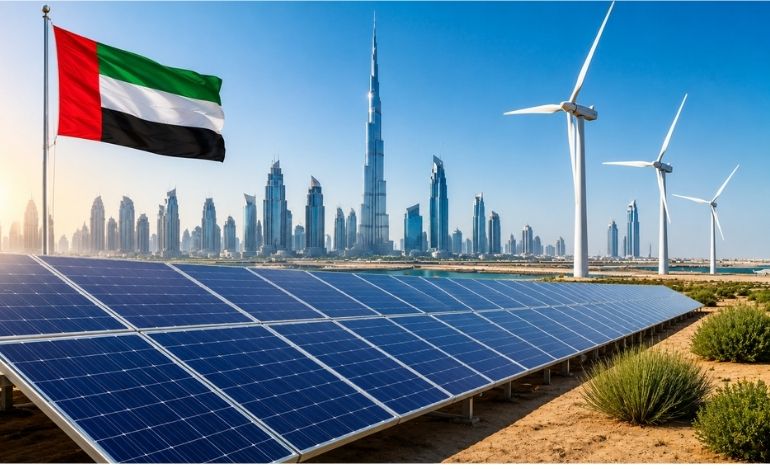

The UAE’s renewable energy capacity has grown more than 63-fold over the past decade as the Gulf state continues accelerating investment in cleaner power and modernizing its electricity grid.
Renewable capacity rose from just 129 megawatts in 2015 to more than 8.2 gigawatts in 2025, according to Sharif Al Olama, undersecretary for energy and petroleum affairs at the Ministry of Energy and Infrastructure, in comments carried by state-run Emirates News Agency, WAM.
Clean energy now accounts for 32.4 percent of the UAE’s electricity generation, with the government targeting a 35 percent share by 2031. Total electricity generation reached 192,735 gigawatt-hours in 2025, compared with consumption of 174,524 GWh, according to WAM.
These figures highlight the pace of the UAE’s energy transition as the country works to meet rising electricity demand while reducing emissions and maintaining energy security. Under its updated Energy Strategy 2050, the UAE aims to more than triple the share of renewable energy by 2030 and invest between 150 billion dirhams ($40.8 billion) and 200 billion dirhams to keep pace with growing energy demand while sustaining economic growth.
Al Olama said the UAE has made significant progress across the energy sector, including expanding clean energy capacity, developing the national electricity system, strengthening grid interconnection, and deploying modern technologies and data systems to manage the grid and enhance its readiness, WAM reported.
The UAE is also targeting a grid emission factor of 0.27 kg of CO₂ per kilowatt-hour by 2030, a goal tied to the government’s broader ambition of maintaining one of the lowest grid emission factors compared with the global average. According to WAM, electricity generated from clean energy sources exceeded 62.4 gigawatt-hours in 2025, while installed clean energy capacity reached 13,805 megawatts, spanning nuclear power, photovoltaic and concentrated solar power, wind energy, and waste-to-energy sources.
Al Olama attributed this progress to a clear national strategy focused on building a secure and sustainable energy system capable of meeting future demand, supported by close collaboration between federal and local authorities, national companies, and the private sector. He pointed to the launch of the Emirates Monitoring Centre as a key milestone — the first national facility of its kind to provide real-time monitoring of the UAE’s integrated power network by connecting all four electricity utilities.
As part of the centre’s second phase, the ministry also developed and implemented a study to build a renewable energy management program in cooperation with Siemens, aimed at strengthening grid monitoring and coordination among the various entities involved in the national electricity system.
Also Read:
ChatGPT Becomes First AI Chatbot Targeted by Stricter EU Rules
Egypt Reports Strong H1 Growth Across Its Non-Bank Financial Sector