
Bahrain Says Gulf Energy Storage Plan Is Crucial for AI Power Needs

Energy storage must be treated as core infrastructure as Gulf electricity systems contend with surging demand driven by advanced technology, Bahrain’s electricity and water minister said this week.
The boom in data centers and the broader digital economy is creating electricity requirements that few grids were originally designed to handle, Yasser bin Ibrahim Humaidan told the Middle East Energy conference in Dubai. “Storage is no longer a supporting technology; it is core infrastructure,” he said. Humaidan added that the pressure stemming from rising digital technology demand represents an immediate test of whether regional systems can scale generation, transmission, and flexibility fast enough while remaining both secure and sustainable.
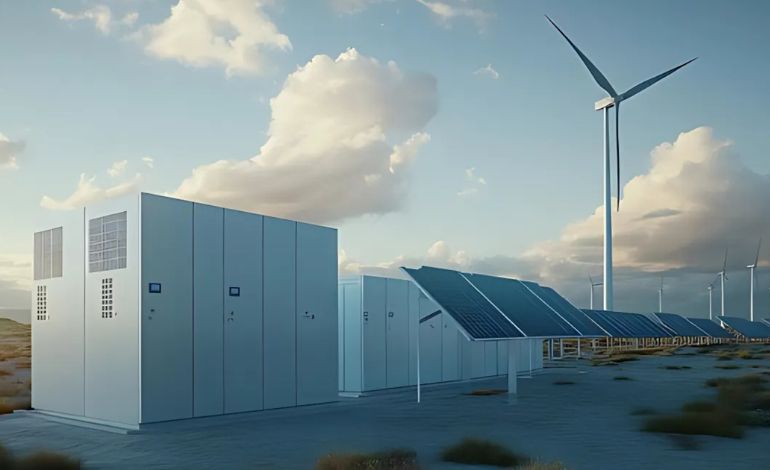
Large-scale battery storage allows electricity networks to maintain continuous power even as generation from wind and solar plants fluctuates. The technology stores energy when renewable output is abundant and releases it when supply drops or demand spikes. Reflecting this shift, Bahrain’s state-backed energy group Bapco Energies and Saudi utility company Acwa Power agreed last December to develop a solar plant paired with large-scale battery storage in Saudi Arabia’s Eastern Province, with electricity from the project intended to feed directly into a Bapco load center in Bahrain.
Power demand across the Middle East is expected to rise 40 percent by 2035, driven in part by data centers, while installed generation capacity is projected to quadruple to more than 2,300 gigawatts by 2050, according to independent research group Rystad Energy. The firm said energy storage is becoming increasingly critical for the region as it positions itself as a global leader in renewables, particularly solar and wind. The six member states of the Gulf Cooperation Council — Bahrain, Qatar, Kuwait, Oman, Saudi Arabia, and the UAE — are targeting around 165 gigawatts of renewable capacity by 2030, having installed roughly 24 gigawatts so far.
Speaking at the same conference, the UAE’s minister of energy and infrastructure, Suhail Mohamed Al Mazrouei, said greater cross-border interconnection will be necessary to help grids adapt to these new pressures. “We need to ensure that interconnectivity between countries and continents is a project to be pursued,” he said, adding hope that investors would continue backing interconnection projects aimed at optimizing the global grid. Gulf states currently have access to a regional grid overseen by the GCC Interconnection Authority, which links all six nations and is being extended to reach Iraq as well, though it is primarily used for emergency backup power rather than routine supply, as countries generally rely on their own domestic networks.
Even with these efforts, the power industry may struggle to expand quickly enough to meet the full scale of demand growth driven by AI, according to Javier Cavada, president and chief executive for Europe, the Middle East, and Africa at Mitsubishi Power. The company, part of Japan’s Mitsubishi Heavy Industries and operator of an assembly plant in Saudi Arabia, supplies gas turbines and other power generation infrastructure. “The demand is being capped by our capacity to produce,” Cavada told AGBI at the conference, noting that global order volumes for gas turbines have surged, prompting manufacturers to build new factories and expand production capacity in response.
Despite disruption caused by the ongoing US-Iran conflict, Cavada said Gulf governments and companies have actually accelerated their commitments to power projects scheduled for delivery between 2028 and 2030.
Also Read:
Oil-Fueled Growth Pushes GCC Corporate Profits to $74.8 Billion