



Rubio Heads to Beijing Despite Sanctions and Diplomatic Tensions
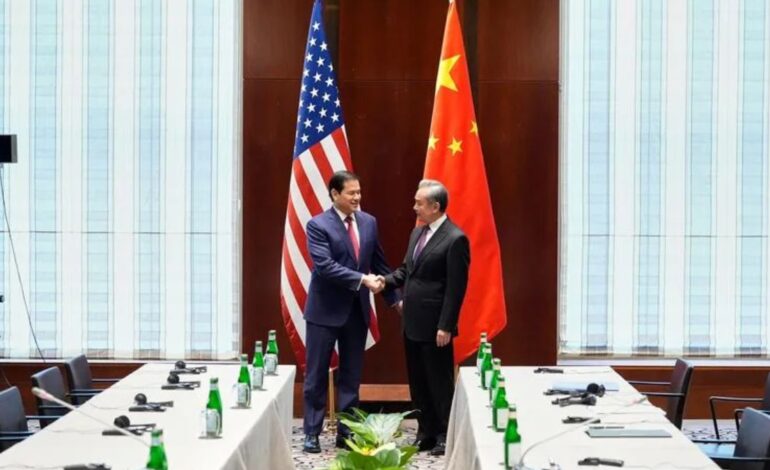

Secretary of State Marco Rubio is traveling to Beijing with President Donald Trump this week, a visit made possible by what appears to be a creative diplomatic workaround: China changed how it transliterates his name, allowing him to enter despite an entry ban imposed under the old spelling.
The arrangement reveals how even serious diplomatic tensions can yield to practical necessity and creative problem-solving when both sides find mutual benefit in proceeding. It also illustrates the pragmatism that often lurks beneath official rhetoric and symbolic gestures in international relations.
A Sanctions Workaround
When Rubio was a U.S. senator, he was sanctioned twice by China for his fierce advocacy of human rights, including vocal opposition to Beijing’s alleged use of forced labor against the Muslim Uyghur minority and its crackdown in Hong Kong. The sanctions included an entry ban that technically prevented him from visiting China.
Shortly before Trump took office in January 2025, Chinese state media and government officials began using a different Chinese character to represent the first syllable of Rubio’s surname. Two diplomats confirmed they believed China made this change specifically because Rubio was under sanctions under the old spelling—the new transliteration allowed him to enter despite the formal ban remaining in place under his previous name.
While the Chinese embassy did not immediately comment on the transliteration change, the timing and context suggest a deliberate decision to facilitate Rubio’s visit while maintaining the formal appearance of sanctions against his previous name.
A Shift in Approach
Rubio’s journey to Beijing represents a significant shift from his previous positions. As a senator, he was among Congress’s most vocal critics of Chinese human rights practices and was a key author of sanctions legislation targeting China over forced labor allegations.
At his confirmation hearing as secretary of state, Rubio continued this critical tone, describing China as an “unprecedented adversary” and emphasizing human rights concerns. Yet since taking office, he has aligned himself with Trump’s approach—prioritizing trade negotiations and diplomatic relationship-building while largely sidelining human rights advocacy.
Trump’s Friendship Framework
Trump has repeatedly described Xi Jinping as a friend and has focused on developing trade relationships while downplaying human rights issues. Rubio’s support for this approach represents a notable repositioning from his previous stance.
However, Rubio has maintained one critical position: he has stated that the Trump administration will not negotiate over Taiwan’s future—the self-governing democracy China claims as its own—in order to secure trade concessions. This represents a clear redline that suggests human rights and democratic values remain part of Rubio’s calculus even as he supports Trump’s broader engagement strategy.
Diplomatic Pragmatism
The name transliteration workaround illustrates a broader principle in international relations: formal positions and symbolic gestures can coexist with practical accommodations when mutual interests align. China retained the formal sanctions while enabling Rubio’s visit. The United States got high-level diplomatic engagement while Rubio avoided the embarrassment of being unable to travel to a major power.
Both sides benefited from a solution that allowed them to proceed while maintaining the appearance of principled positions. This kind of creative diplomacy is often invisible to the public but essential to how major powers navigate their relationships.
The Larger Negotiation
Rubio’s Beijing visit comes at a critical moment in U.S.-China relations, with trade negotiations ongoing and various geopolitical flashpoints—including Taiwan, technology access, and regional influence—requiring careful management. His presence signals Trump’s willingness to engage directly with Chinese leadership despite rhetorical tensions.
For Rubio personally, the visit represents another step in his transition from congressional critic to senior administrator executing presidential policy—a transition that sometimes requires setting aside previous positions in service of broader strategic objectives. Whether this represents pragmatic leadership or inconsistency depends largely on one’s perspective on how national interests should be balanced against human rights advocacy.
Also Read:
Startup Ecosystem Maintains Growth as MENA Faces Political Tensions
CRDB Bank Opens Dubai Office to Channel Gulf Capital into Africa’s $3.4 Trillion Economy