






Trump Expected to Speak on Possible Easing of Marijuana Rules This Thursday
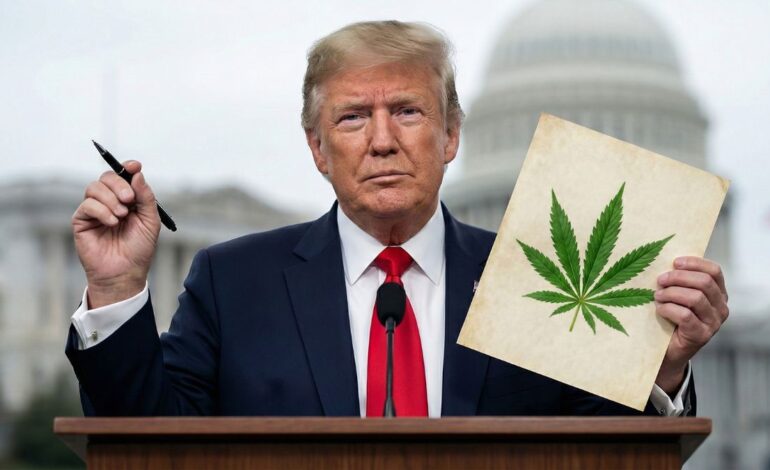

In a move that could redefine America’s relationship with cannabis, President Donald Trump is expected to address the potential loosening of federal marijuana regulations this Thursday. According to a White House official, the President is considering an executive order to reclassify marijuana under the Controlled Substances Act, a decision that would mark one of the most significant federal drug policy changes in over 50 years.
The announcement follows Trump’s comments to reporters in the Oval Office on Monday, where he stated, “We are looking at that very strongly,” in reference to moving cannabis from Schedule I to Schedule III.
The Weight of Schedule I
For decades, federal policy has placed marijuana in the most restrictive category: Schedule I. This classification, shared with heroin and LSD, defines the substance as having “no currently accepted medical use” and a “high potential for abuse.” This status has created a profound conflict with state laws, where 38 states have legalized medical cannabis and 24 have approved recreational use.
The Schedule I designation is the root of the cannabis industry’s most significant hurdles. It prevents federally insured banks from servicing cannabis businesses, blocks institutional investment, imposes heavy tax burdens under IRS code 280E, and severely restricts scientific research into the plant’s medical benefits.
What a Move to Schedule III Would Mean
Reclassifying marijuana to Schedule III would recognize it as having a “moderate to low potential for physical and psychological dependence.” This category includes substances like Tylenol with codeine, ketamine, and anabolic steroids.
The practical implications would be transformative:
- Medical Legitimacy: It would formally acknowledge accepted medical uses, validating state medical cannabis programs and potentially accelerating FDA-approved research and drug development.
- Financial Normalization: It could open the door for banks and credit card companies to work with state-legal cannabis businesses without fear of federal prosecution, solving the industry’s long-standing banking crisis.
- Economic Relief: Businesses would likely be freed from the punitive 280E tax provision, which prohibits standard business deductions, allowing them to reinvest profits and stabilize operations.
- Criminal Justice Impact: While not descheduling the drug entirely, a lower classification could influence federal sentencing and prompt a review of past convictions, though significant criminal justice reform would require separate legislative action.
The Path Forward and Industry Reaction
The Biden administration had already initiated a review through the Department of Health and Human Services (HHS), which recommended the move to Schedule III. The final authority rests with the Drug Enforcement Administration (DEA), which must conduct its own review.
The market reacted immediately to the news, with shares of cannabis companies surging on the potential for a more stable operating environment. Industry advocates emphasize the broader significance. “Rescheduling… would show that the federal government is real about coming up with a solution so that these businesses can operate like every other business,” said Steve Levine of Husch Blackwell’s cannabis practice.
A spokesperson for Canopy Growth noted it would be “an important step toward normalizing cannabis policy, improving research, and expanding access to regulated and safe channels.”
A Cautious Wait for Details
While the anticipation is high, the White House official cautioned that details remain speculative until a formal announcement. Key questions linger about the timeline, the specific language of any executive action, and how agencies like the DEA and Treasury will implement changes.
If President Trump follows through, Thursday’s expected remarks could signal the beginning of the end for federal cannabis prohibition as it has existed since 1970. It would represent a monumental shift toward aligning federal law with state legislation and public opinion, where a strong majority supports legalization. The move would not create a federally legal adult-use market overnight, but it would dismantle the primary federal barriers that have stifled a multibillion-dollar industry and constrained scientific understanding for generations.