


Greenland prepares next generation for mining future
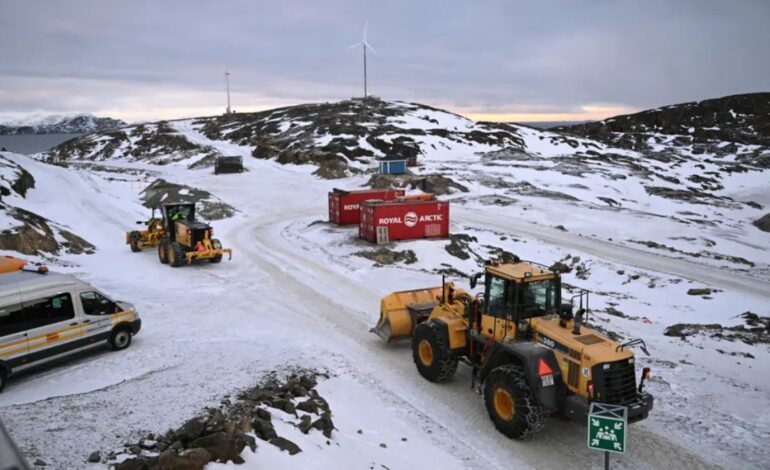

In the coastal town of Sisimiut, a dozen students in high-visibility vests and hard hats are learning to operate bulldozers, dump trucks, and excavators. They are not construction workers preparing for a housing project. They are the first wave of a new generation that Greenland hopes will build its economic future.
The Greenland School of Minerals and Petroleum, founded in 2008, offers three-year vocational training to students from across the vast Arctic territory. Beyond the heavy equipment operation happening in its practical classes, students study geology, rock mechanics, mathematics, and English—a curriculum designed to equip them for careers in an industry that Greenland’s government believes will deliver financial independence.
A Dream of Autonomy
Greenland has been an autonomous territory of Denmark since 2009, when it gained control over its raw materials and minerals. Today, the local government relies heavily on Danish subsidies to supplement revenue from fishing. The dream is that mining and tourism will eventually generate enough income to cut those ties entirely.
“The school was created because there is hope for more activities in mining,” said director Emilie Olsen Skjelsager, “but also to have more skilled workers in Greenland for heavy machine operating and drilling and blasting, and exploration services.”
Teacher Kim Heilmann watches his students maneuver heavy equipment with a dual mission: technical instruction and motivational inspiration. “I want them to know it’s possible to mine in Greenland if you do it the right way,” he said. “But mostly the challenge is to make them motivated about mining.”
The Challenge of Isolation
Motivation does not come automatically. Greenland’s existing mines are located in remote areas, and the isolation of such work discourages many potential recruits. Of the students who complete the program, only a small number—perhaps five each year—will ultimately work in mines. The rest will find employment on construction sites, their skills transferable but their mining-specific training underutilized.
Greenland’s population of 57,000 has historically relied on foreign workers to develop mining projects, lacking sufficient local expertise. Deputy Minister of Mineral Resources Jorgen T Hammeken-Holm acknowledged the gap. “We have some good people that can go out mining and blasting and drilling,” he said. “But if you have a production facility close to the mining facility, then you need some technical skills in these processing facilities. There is a lack of educated people to do that.”
What Lies Beneath
Inside the school, a glass case displays minerals believed to lie beneath Greenland’s surface: cryolite, anorthosite, eudialyte—the last containing rare earth elements essential to green and digital transitions. According to the Geological Survey of Denmark and Greenland (GEUS), the territory is home to 24 of the 34 critical raw materials identified by the EU as strategically important.
“New mine sites have been searched all over Greenland,” said 30-year-old student Angerla Berthelsen, who hopes to find work in mining. “Lots of possibilities,” he added optimistically.
But questions persist about the actual size and commercial viability of these deposits. GEUS cautions that while Greenland hosts a variety of geological terrains formed by different processes, “only in a few cases have the occurrences been thoroughly quantified, which is a prerequisite for classifying them as actual deposits.”
Hammeken-Holm was blunter. “It’s more or less a guess for now. Nobody knows actually.”
Infrastructure Hurdles
Beyond resource uncertainty, Greenland faces formidable infrastructure challenges. The island has no roads connecting its towns. Its Arctic climate is harsh. Large-scale mining would require investments in transport, power, and logistics that currently do not exist.
Today, only two mines operate on the island: a gold mine in the south and an anorthosite mine on the west coast. The gap between aspiration and reality remains wide.
A Generation in Training
Still, the students in Sisimiut continue their training. The Greenlandic government pays their tuition and provides a monthly stipend of approximately 5,000 kroner ($800). For young Greenlanders facing a future where traditional livelihoods like hunting and fishing are expected to decline, mining offers an alternative path.
Whether that path leads to prosperity depends on factors beyond their control: the actual quantity of minerals beneath the ice, global commodity prices, infrastructure investment, and the political will to develop an industry that remains, for now, more dream than reality.
But in a schoolyard in Sisimiut, a dozen students climb into excavators and practice their turns. They are learning to operate machines that, one day, might help build their nation’s independence. For now, they are simply learning. And hoping.
Also Read:
New Italy Migration Law Allows Naval Blockades on Migrant Ships
36 Dead and Thousands Homeless After Cyclone Gezani Hits Madagascar