




Australia Investigates Foreign Influence Network, Charges Two Chinese Nationals

In a significant national security move, Australian authorities have charged two Chinese nationals with foreign interference, alleging they spied on a Buddhist group at the direction of Chinese police.
The pair—a 25-year-old man and a 31-year-old woman—were each charged with one count of “reckless foreign interference,” an offense carrying a maximum prison sentence of 15 years. Police will allege in court that the two worked with another Chinese national charged last August, collecting information covertly on the Guan Yin Citta Buddhist group based in Canberra.
According to Australian Federal Police, the individuals operated under the direction of China’s Public Security Bureau, the country’s primary domestic law enforcement agency.
Investigation Sparked by Intelligence Tip
The investigation began last year following a referral from Australia’s domestic spy agency, the Australian Security Intelligence Organisation (ASIO). ASIO chief Mike Burgess warned that the security environment is becoming “more dynamic, diverse and degraded,” noting that “multiple foreign regimes are monitoring, harassing and intimidating members of our diaspora communities.”
“This sort of behaviour is utterly unacceptable and cannot be tolerated,” Burgess stated.
Targeting Diaspora Communities
Police emphasized that diaspora groups are often the target of such activities. Assistant Commissioner Stephen Nutt, who leads counter-terrorism and special investigations, cautioned that “Australia is not immune to foreign interference,” and this case would not necessarily prevent further attempts.
“Members of our culturally and linguistically diverse communities are more likely to be victims of foreign interference or transnational repression than to be offenders,” Nutt added.
The Guan Yin Citta group, which describes its mission as encouraging scripture recitation, life liberation, and making vows to help others, claims millions of followers worldwide. It was founded by the late Lu Jun Hong, known as Master Lu.
Bilateral Context: Strained Ties and Economic Tensions
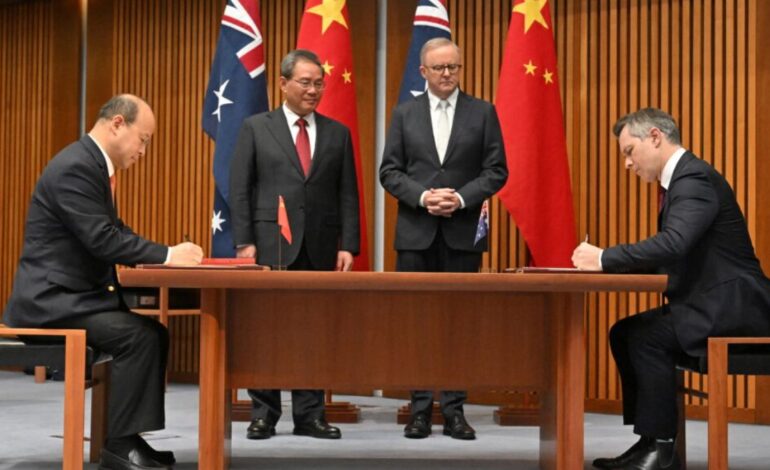
The charges come amid a complex relationship between Canberra and Beijing, which has seen both friction and cautious diplomacy. Over the past decade, ties have been strained by national security concerns and strategic competition in the Pacific.
While relations showed signs of thawing in 2024—marked by China lifting its ban on Australian rock lobster imports—underlying tensions over influence and interference persist. China remains one of Australia’s most vital economic partners, accounting for nearly one-third of its total trade.
China’s embassy in Canberra had not responded to a request for comment at the time of reporting.
This case highlights the ongoing challenge Western nations face in balancing economic partnerships with the need to protect their institutions and communities from extraterritorial pressure. For Australia, it reinforces a continued commitment to confronting foreign interference, even when it involves a major trading power.
Also Read:
Thousands Protest in Australia During President Herzog’s Visit
Italian Man at Center of Bosnia’s Weekend Sniper Killings Probe