
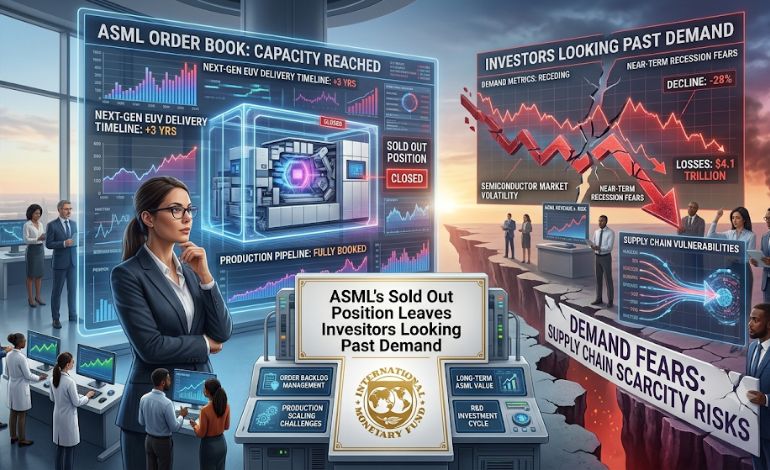
ASML’s Sold Out Position Leaves Investors Looking Past Demand

Christophe Fouquet, ASML’s chief executive, told shareholders in April that Europe’s most valuable company will “by all possible means” avoid becoming the chip industry’s bottleneck.
Six months later, Fouquet admitted that ASML’s supply of chip-printing machines needed to make the advanced logic and memory chips powering the AI boom will fall short of demand in 2027 and 2028.
The question for customers, investors and ASML itself, whose shares have jumped over 70 percent this year, is whether it can boost capacity fast enough to meet the voracious demand. Meanwhile, the market is nervous about the longevity of the AI boom, with estimates stretching years into the future.
ASML itself is now the bottleneck,” said Han Dieperink, chief investment officer at asset management firm Aureus, which owns ASML shares, adding management was publicly recognising planned 30% capacity additions in 2027 and in 2028 will not be enough.
He added talks about future purchases are already spilling into 2029 and 2030, which he interpreted as a sign that demand could continue to outpace supply long beyond the present cycle.
But Fouquet gave investors comfort on one issue Wednesday: ASML’s own supply chain, including crucial optical systems maker Zeiss, is not the bottleneck.
Investors argue the company’s valuation reflects the increased uncertainty beyond 2028. But since June, ASML’s stock price has drifted down in relation to its future profitability, even as financial analysts have raised earnings expectations.
Mark Sloan, Senior Analyst at Stonehage Fleming, whose Global Best Ideas fund holds a 3.5% stake in ASML, said the stock has become appealing on the strength of its growth potential and market dominance, with the valuation down to around 30 times forward earnings from more than 45 times in June.
Also Read:
Israel Army Chief says Strengthening Armed Forces on all Fronts
Syria Intends to Increase the $493 Million in World Bank Grants