

Stranded Shark Remains in South Korean Canal Despite Repeated Rescue Efforts
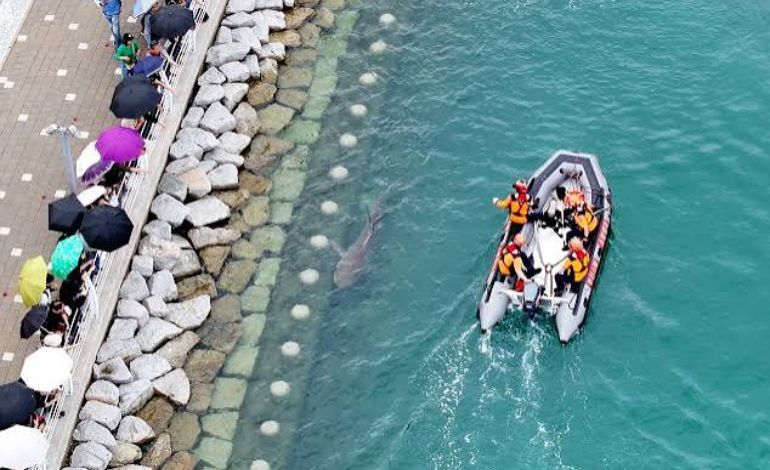

A second attempt to guide a shark stranded in a canal in the South Korean port city of Busan back out to open water ended without success on Friday, leaving the animal in the waterway for a third week running.
Rescuers, who had been using a large net to try to coax the shark out, called off the operation after a two-hour chase due to the risk of the net snagging on rocks. They now hope the shark will eventually swim out on its own, having left the net in place to limit how far back up the canal it can go.
The 3.5-meter shark was first spotted in a narrow waterway at North Port on September 18. Nicknamed Bukangi, a name derived from Buk Hang, the Korean term for North Port, the animal has drawn roughly 600,000 visitors to the area. Experts believe it may be a bronze whaler, a species typically found in warm temperate waters and occasionally spotted off South Korea’s coast.
The shark’s extended stay has drawn particular attention because of its unusual location, a narrow canal in North Port close to high-rise buildings and a major high-speed rail station in the heart of Busan. Authorities first tried guiding the shark toward the sea on Tuesday using vessels equipped with water jets, but the animal swam away from the jets and stayed put. For the second attempt, officials deployed a net 50 meters long and 6.8 meters high to keep the shark from turning back into the canal, with a vessel pulling the net’s center while five people on each side moved along the waterfront in coordinated fashion to guide it toward open water. The shark remained in the canal regardless, and the net now restricts it to a 100-meter stretch leading toward the sea.
Kim Hyun-woo, a senior researcher at the National Institute of Fisheries Science leading the operation, said as water levels and currents shift, the team expects the shark may eventually be able to find its own way out, adding that the operation can be considered a success once it’s confirmed the shark has fully left the canal for open water. He said noise, lights and electrical signals may be making it harder for the shark to find its way, describing the canal as overwhelming the animal with physical stimuli coming from too many directions at once.
Hundreds of people gathered along the waterway Friday to watch the rescue effort, with some expressing sadness at the prospect of the shark leaving and others saying it should be returned to its natural habitat as soon as possible. Busan resident Jo Won-ho said he hopes it eventually heads back out to open water, though he joked that the shark seems to like Busan too, given how long it has stayed.
Bukangi’s appearance has also drawn attention to broader changes in the waters around South Korea, with experts pointing to warming sea temperatures as a possible factor behind a growing number of large shark sightings. An analysis by the National Institute of Fisheries Science found 46 sightings of large sharks along the country’s east coast during the first half of this year, compared with just 12 over the same period last year.
Also Read:
Saudi Transformation Opens New Opportunities for Portugal, Envoy Says
Saudi Arabia Provides Assistance to 174 Flydubai Passengers After Emergency Landing