
How Saudi Arabia Is Preserving Heritage While Promoting Modern Creativity

In the vast desert landscape of AlUla, where sandstone cliffs hold inscriptions carved thousands of years ago, a quiet revolution is unfolding. It is not a rupture with the past, but a continuation—an unbroken thread stretching from the woven textiles of nomadic encampments to the monumental installations of contemporary artists.
Saudi Arabia’s cultural momentum, now visible to the world, did not emerge suddenly. It is the natural flowering of seeds planted over centuries.
The Deep Roots
Long before museums dotted the Kingdom’s cities, Saudi artisans worked with materials drawn directly from their environment. Palm fronds became intricate baskets. Clay from the earth transformed into functional ceramics. Camel hair, spun and dyed, became Al-Sadu textiles—each pattern carrying the memory of its maker and the stories of her tribe.
These traditions are not relics. Al-Sadu weaving is inscribed on UNESCO’s Intangible Cultural Heritage list, a formal recognition of what Saudi communities have always known: that craft is not separate from identity, and that the functional object can also be an expression of artistry and belonging.
AlUla: Where Time Layers Upon Itself
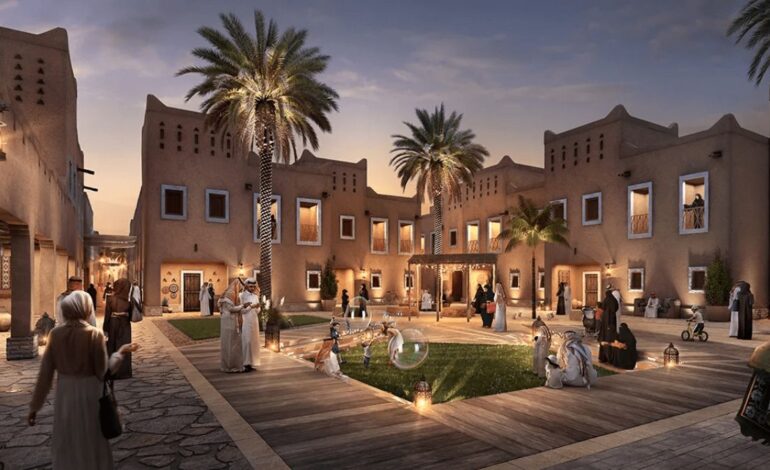
Nowhere is the continuum more visible than in AlUla, a region of 7,000 years of human history. Here, Nabataean tombs stand carved into rock faces at Hegra, the Kingdom’s first UNESCO World Heritage site. Thousands of ancient inscriptions at Jabal Ikmah preserve the voices of civilizations long passed. Restored mudbrick homes in the Old Town recall a more recent but equally resonant past.
Yet AlUla is not a museum of frozen history. It is a living canvas.
This winter, the AlUla Arts Festival brought together these layers of time in a season of extraordinary cultural density. Desert X AlUla 2026, now in its fourth edition, scattered monumental works across the desert floor. Under the theme “Space Without Measure”—inspired by the Lebanese-American poet Kahlil Gibran—artists responded to AlUla’s infinite horizons.
Saudi artist Mohammed Al-Saleem installed celestial-inspired geometric sculptures. Cuban-American artist Maria Magdalena Campos-Pons translated the colour of AlUla’s sunsets into pigment and form. Agnes Denes, a pioneering figure in environmental art, erected a living pyramid of indigenous plants, transforming the oasis into a vertical landscape. Eleven artists, each speaking to our relationship with the natural world, their works conversing not only with each other but with the ancient stones that surrounded them.
Craft Meets Contemporary
In the AlJadidah Arts District, “Material Witness: Celebrating Design From Within” offered another perspective on this dialogue. Heritage craft and material research from Madrasat Addeera—a local initiative preserving and evolving traditional techniques—sat alongside works by regional and international designers. The exhibition demonstrated how heritage materials can be translated into contemporary forms without losing their essence.
Nearby, the AlUla Music Hub filled the streets with local musicians, adding an auditory dimension to the visual feast. Music, like the visual arts, carries memory forward.
A New Institution Takes Root
Perhaps the most significant signal of AlUla’s cultural trajectory is the opening of “Arduna,” the inaugural exhibition of the AlUla Contemporary Art Museum. Co-curated with France’s Centre Pompidou, the exhibition places Saudi and regional artists alongside modern masters. Picasso and Kandinsky share gallery space with Etel Adnan, Ayman Zedani, and Manal AlDowayan.
The message is deliberate and clear: AlUla is not merely receiving global culture but participating in its creation. A museum rooted in the heritage and environment of this place is emerging as an institution of international standing, with local voices contextualized among world masters rather than subordinated to them.
A Different Kind of Cultural Rise
What distinguishes Saudi Arabia’s cultural transformation is not its scale—though the scale is indeed extraordinary. It is the sense of continuity. This is not an imported model grafted onto unfamiliar soil. It is the flowering of traditions that never died, practiced by artisans who never stopped working, in landscapes that have inspired human creativity for millennia.
The Kingdom’s cultural future is being shaped not by sudden inspiration alone, but by the meeting of deep roots with the imaginative voices of the present. Heritage provides the foundation; contemporary creativity provides the wings.
The journey is only accelerating. Rooted in the past, open to the world, Saudi Arabia’s cultural story continues to unfold—one exhibition, one installation, one woven thread at a time.
Also Read:
Bangladesh Elections 2026: BNP Announces Win, What Happens Next?
Travel Trends 2026: Canadians Look for Magic Outside the United States