





North Korea Says Missile Test Responds to Growing Global Tensions
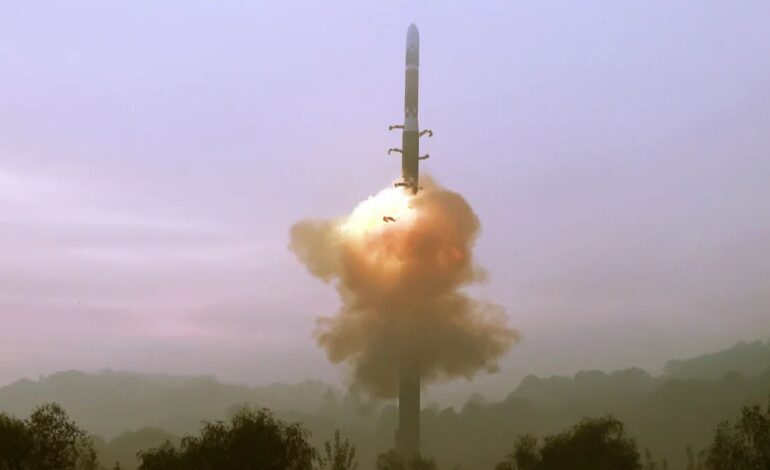

North Korea has opened 2026 with a stark and familiar reminder of its military ambitions, framing its first missile launch of the year as a direct response to a world it perceives as increasingly hostile. The test, personally overseen by leader Kim Jong Un, was not presented as a routine drill but as a necessary action compelled by global events.
State media reported Monday that the launch involved a “cutting-edge” new hypersonic missile system, a weapon designed to evade modern air defenses. Kim Jong Un, who notably was not present for the initial test of this system last October, took center stage this time. He declared that “important achievements have been recently made in putting our nuclear forces on a practical basis and preparing them for an actual war.”
The Justification: A “Geopolitical Crisis”
The rationale offered by Pyongyang is particularly telling. The Korean Central News Agency (KCNA) quoted Kim stating the drill was made necessary by “the recent geopolitical crisis and complicated international events.”
This language is almost certainly a direct reference to last week’s U.S. capture of Venezuelan President Nicolás Maduro. North Korea swiftly condemned that raid as a “serious encroachment of sovereignty.” For the insular regime in Pyongyang, the spectacle of a foreign leader being seized and brought to the United States for trial represents a visceral nightmare—a direct validation of its decades-old claim that Washington seeks regime change. The missile test, therefore, serves a dual purpose: advancing weapons technology while broadcasting a deterrent message that says, “This will not happen here.”
Timing and Regional Calculations
The timing of the provocation is equally strategic. The missiles flew into the Sea of Japan as South Korean President Lee Jae Myung was embarking on a four-day visit to China, his nation’s largest trading partner. Lee’s trip aims to bolster economic ties and, significantly, to enlist China’s influence in support of his efforts to improve relations with the North.
North Korea’s launch acts as a disruptive signal to both Seoul and Beijing. It undermines Lee’s diplomatic overtures by demonstrating Pyongyang’s unilateral and belligerent posture, and it reminds China that its neighbor remains a volatile actor, even as Beijing hosts the South Korean president.
An Accelerating Cycle
The test confirms the continued acceleration of North Korea’s weapons programs under the guise of “practical” war preparation. Each launch serves to refine technology, intimidate adversaries, and solidify the regime’s defensive—and potentially offensive—posture.
For the international community, the event underscores a frustrating and dangerous cycle. Actions perceived as enforcing global norms, such as the Maduro capture, are leveraged by Pyongyang to justify escalations that further destabilize Northeast Asia. It leaves diplomats grappling with an old but intensified dilemma: how to address proliferation and aggression from a state that views every global crisis as a reason to build more weapons, not to seek dialogue.
As the missiles splashed down 620 miles away, they sent ripples far beyond the Sea of Japan. They signaled a year that is beginning where the last one ended: with a fortified, anxious North Korea watching the world’s conflicts and responding with demonstrations of firepower.
Also Read:
Trump Signals Military Response After Venezuela Raid Involving Colombia
Bangladesh Sends 750,000 Workers to Saudi Arabia, Sets New Record