






Trump Reveals Proposal for Building a New US Navy Battleship
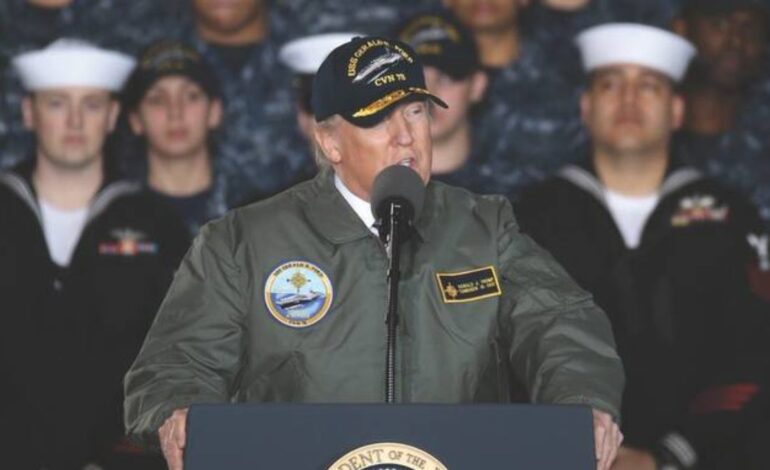

In a striking announcement from his Mar-a-Lago resort, President Donald Trump revealed plans for what he describes as a transformative addition to American naval power: a new, massive battleship. This vessel, he proclaimed, would be the cornerstone of a future “Golden Fleet,” surpassing all historical predecessors in size, speed, and sheer force.
“The biggest, the fastest, and by far 100 times more powerful than any battleship ever built,” Trump asserted, outlining a warship that would outsize the legendary Iowa-class battleships of World War II. Its proposed armament reads like a page from science fiction—hypersonic missiles, railguns, and high-powered lasers, technologies the Navy is still actively developing.
The announcement arrives at a complex moment for naval procurement. Just last month, the Navy canceled its troubled program for a new, small warship due to delays and soaring costs, opting instead for a modified Coast Guard cutter. This move follows a pattern of challenges in delivering new designs, such as the Ford-class aircraft carriers and Columbia-class submarines, on time or on budget.
Historically, the term “battleship” evokes images of towering, heavily armored behemoths bristling with giant naval guns, the undisputed kings of the sea through the Second World War. Their dominance faded rapidly in the face of aircraft carriers and long-range missile technology. The U.S. Navy’s final flirtation with the class ended in the 1990s, after briefly modernizing four Iowa-class ships in the 1980s.
Trump’s vision, therefore, is not merely a proposal for a new ship, but a potential reimagining of naval hierarchy. It also underscores his long-standing, hands-on interest in the aesthetics and specifics of the fleet. During his first term, he famously advocated for steam catapults over modern electromagnetic launch systems on new carriers. He has repeatedly complained about the appearance of ships, from their design lines to rust on their hulls, even claiming personal credit for redesigning the look of the now-canceled Constellation-class frigate.
He indicated this new project would be no exception. “The US Navy will lead the design of these ships along with me, because I’m a very aesthetic person,” he stated, promising a direct presidential role in its conception.
The proposal raises immediate and profound questions. Can the ambitious fusion of unproven technologies be engineered and integrated effectively? What would the strategic role of such a colossal, eye-catching vessel be in a modern navy built around carrier groups, submarines, and distributed warfare? And, amidst existing procurement struggles, what would the astronomical cost—not just in dollars, but in shipyard resources and focus—mean for the rest of the Navy’s urgent modernization needs?
While the image of a resurrected battleship armed with futuristic weaponry captures the imagination, the path from a Mar-a-Lago announcement to a deployed warship is long and fraught with technical, financial, and strategic hurdles. The vision of a “Golden Fleet” is bold, but it sets sail into the uncertain waters of reality, where budget sheets, engineering challenges, and strategic doctrine will ultimately determine its fate.
Also Read:
Big Changes in American Diplomacy Raise Questions About Policy Direction
Japan Prepares to Restart the World’s Biggest Nuclear Plant After 15 Years