



China and US Call for Thailand–Cambodia Ceasefire Before ASEAN Meeting

With casualties mounting and over half a million people displaced, the United States and China have launched urgent, separate diplomatic efforts to halt renewed fighting between Thailand and Cambodia. The push comes just days before a critical emergency meeting of Southeast Asian foreign ministers, aiming to salvage a shattered peace in the region’s most severe border conflict in recent history.
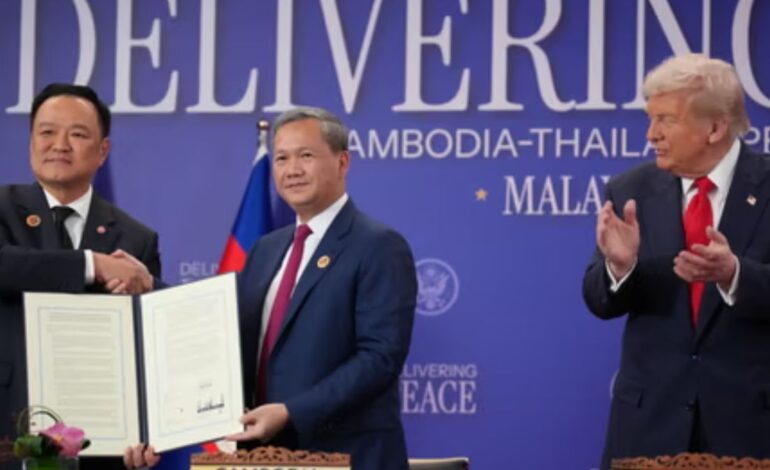
Hostilities resumed last week, breaking a ceasefire brokered by President Donald Trump in late July. Since then, approximately 60 people have been killed, and the fighting has expanded along the contested 817-kilometer border. The intensity of this latest round of clashes has alarmed the international community, threatening regional stability and testing the unity of the Association of Southeast Asian Nations (ASEAN).
Diplomatic Fronts Open in Washington and Beijing
In a flurry of phone calls, top diplomats sought to de-escalate the crisis. U.S. Secretary of State Marco Rubio spoke with Thai Foreign Minister Sihasak Phuangketkeow on Friday, reiterating Washington’s deep concern and urging a return to the July ceasefire agreement. The State Department emphasized the call as part of ongoing American engagement to promote peace.
Concurrently, Chinese Foreign Minister Wang Yi held discussions with his counterparts from both Thailand and Cambodia. According to China’s Foreign Ministry, both nations “expressed their desire to ease tensions and achieve a ceasefire.” China, which has dispatched a special envoy to the region, warned that continued conflict “will benefit neither side and will undermine ASEAN unity,” framing the crisis as a threat to regional cohesion.
ASEAN’s Precarious Mediation and a Crucial Meeting
The diplomatic overtures set the stage for a pivotal gathering in Kuala Lumpur on Monday. Malaysian Prime Minister Anwar Ibrahim, the current ASEAN chair who helped mediate the initial July truce, has expressed cautious optimism. He noted that the prime ministers of both Thailand and Cambodia have shown a willingness to find an “amicable solution.”
This meeting will mark the first face-to-face discussions between the two governments since fighting erupted on December 8. The success of this ASEAN-led forum is crucial, as the bloc’s credibility hinges on its ability to manage conflicts between its own members.
A Deep-Seated Dispute with Shifting Blame
The roots of the conflict are long-standing, centered on disputed temple complexes and border areas. The fragile July ceasefire, later expanded in October, collapsed amid mutual recriminations. Thailand suspended de-escalation measures last month after accusing Cambodia of laying new landmines—a charge Phnom Penh denies. Cambodia, in turn, maintains it is only acting in self-defense against Thai military actions.
On the ground, the situation remains volatile. As recently as Friday, both sides exchanged heavy weapons fire across the frontier. Bangkok insists any new ceasefire must begin with Cambodia halting hostilities and presenting a clear proposal, while Phnom Penh holds firm to its defensive posture.
The Stakes for Regional Order
The conflict presents a significant challenge for ASEAN’s principle of non-interference and its consensus-based diplomacy. The involvement of both the U.S. and China highlights the geopolitical dimensions at play, with both powers vying for influence in Southeast Asia.
As foreign ministers prepare to meet in Kuala Lumpur, the world watches to see if regional diplomacy, bolstered by global pressure, can once again silence the guns. The outcome will not only determine the fate of countless displaced civilians but also signal whether Southeast Asia’s premier political bloc can effectively keep the peace within its own borders. The path to a lasting solution remains fraught, but the urgent calls from Washington and Beijing have made clear that the time for dialogue is now.
Also Read:
US Pressures EU Over Use of Frozen Russian Assets for Ukraine Support
Trump Expected to Speak on Possible Easing of Marijuana Rules This Thursday